

The Joyful Performance Model
- Aug 4
- 4 min read
When I tell people what I do, helping organizations improve performance through developing behaviors and systems that engage employees and bring more joy to work, there are a few typical responses.
The most common is, "So you help companies with the annual review cycle?"
Yes and no.
Yes, if an organization doesn't have a working yearly goal and review cycle, then yes, I can help with that. Frankly, any HCM can facilitate that type of yearly check-in on long-term goals.
No, in that my passion lies in the day-to-day, week-to-week performance management process.
If you know what I mean, you've had the fortunate opportunity to work in an organization that has such a system in place. Most don't.
Some of you might be thinking... wow, that sounds like a lot of work... and time... I'm already underwater; how could I possibly add that in?
The answer is that you can't afford not to.
Only about one in five employees strongly agree they have a clear definition of what exceptional performance looks like in their role. (Gallup, U.S. Employee Engagement Declines From 2020 Peak, 2026)
A yearly performance review is not going to help anyone clearly understand what exceptional performance looks like. If employees don't understand what exceptional looks like, you can't expect anyone to perform exceptionally. In today's do-more-with-less workplace, that is a difference in cost reduction, revenue-generating innovation, and employee retention.
That's where the Joyful Performance Model comes in. The model is simple and adaptable to your organization.
©2026 Performance Consulting Services, LLC
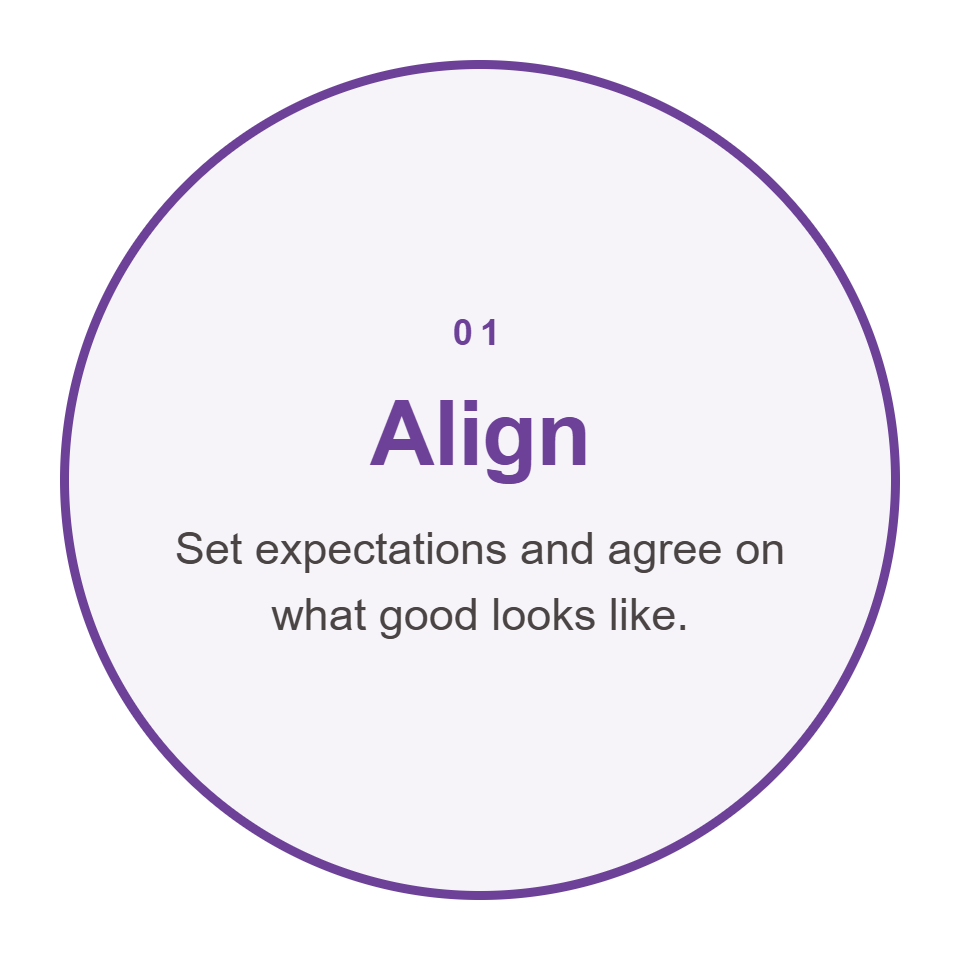
The beginning of the cycle is to align on clear expectations. The word "align" was not an arbitrary choice. It's very different from simply, "set" expectations. While the expectation is coming from the leader, the understanding of what good looks like comes from ensuring the leader and employee both understand it exactly the same way.
Aligning expectations means that all parties involved can clearly articulate and picture what good looks like. This might require some teaching or demonstration. You'll know you're done when you can ask, "What is my expectation of you regarding what we just discussed?" and you agree with the answer.
Next comes observing those expectations in action. When you follow up to see how your expectations are being met, you'll know if you were really aligned. Observation ensures that alignment isn't in one ear and out the other. When you view your employee's behavior and output, you will understand exactly what to praise or course-correct to help them continuously improve.
Observation is a practice that needs to happen regularly. But how do you do it so that people don't feel spied on? How do you make sure you're seeing the real version of their effort, and not a "show" because you're watching?
Align. This time you're setting expectations for yourself. You communicate with your employees, let them know what to expect and how often. Then show up when and how you said you would. At first, you might get a bit of a performance; people going above and beyond because you're watching, but in the long run, you'll see the real them. And if you follow your observations up with quality feedback, they'll trust that you're working with them, not against them.
Which brings us to Celebrate & Enhance.
Celebrate is first on purpose. As human beings, we are hard-wired to look for the worst first. As leaders, we must flip that and start with what we are proud of, excited about, and thankful for. Our world is full of stress and uncertainty. As leaders, it is up to us to set the tone and invite our employees to engage. That starts with showing what we appreciate. Authentically celebrate the outcome of your observations as often as you give opportunity feedback, and you'll see a drop in turnover and an increase in engagement.
At the same time, everyone has behaviors and skills that can be improved. If an expectation is not met during your observation, you must say something. Leaders often hold on to feedback because they are not skilled in delivering it. However, giving honest, straightforward feedback with the intention to help someone is the single most impactful thing any leader can do.
It starts with identifying whether someone has a skill gap (they are not as good at doing the task as required) or a will gap (they don't want to do the task). These two things are addressed very differently. Skill gaps are addressed through teaching or coaching, with specific expectations for intentional improvement. Will gaps are addressed with a heart-to-heart conversation and clear expectations, and if appropriate, transition to the progressive discipline path with HR.
Addressing the gaps becomes how you enhance performance. You've aligned on clear expectations, observed them in action, and given the feedback. Now it's time to plan what happens next. Specific training, side-by-side work, another observation, or perhaps a new elevated expectation to challenge the employee for even more. All of these are options depending on the gap, or lack thereof.
Then, and I bet you saw this coming, you repeat the cycle. As part of your plan, make sure that you're aligned on what the expectations are. They might have shifted or elevated, and you want to make sure you're clear. Then you observe, celebrate & enhance, and repeat. No one is ever "done." All of us, even those at their very best, have opportunities to improve and make more impact.

As a leader, it's your responsibility to know how to manage performance well, but not every company teaches you how. Over the next several weeks, I'll be sharing details about the components of the Joyful Performance Model. Make sure to subscribe to get all the info as it is released, and become a member to access PDF downloads of the model.
If you're interested in working with PCS to implement this model in your business, sign up for a free consultation.
Comments